


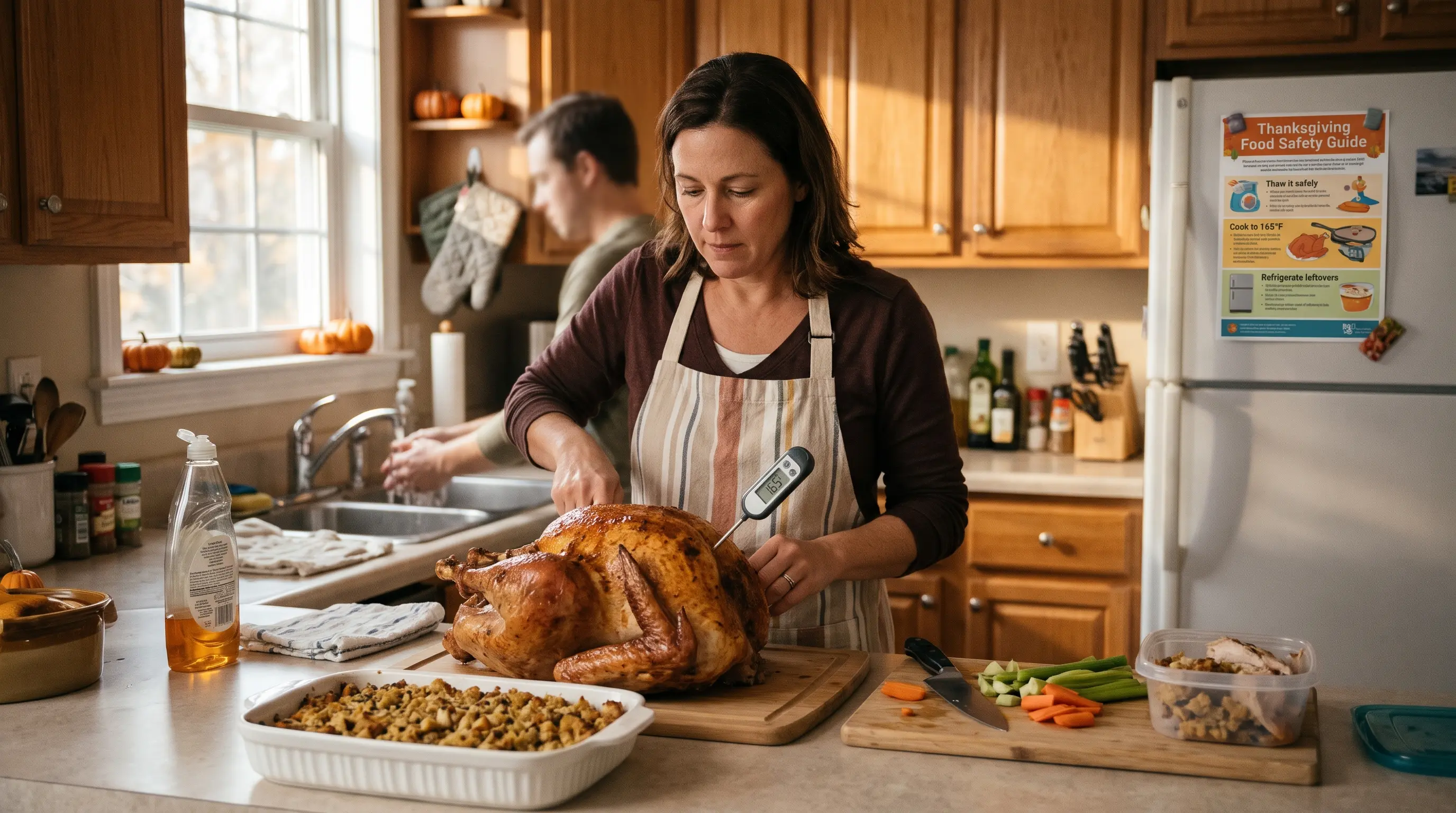
Every November, the same questions reach the health department
Thanksgiving food safety questions reach environmental health departments every year, often in the same week and in nearly the same words.
How long the turkey needs to thaw. Whether the stuffing is done. How long the leftovers are good for.
Residents call the front desk, message the department's social pages, and stop inspectors in the grocery store aisle. Staff answer every one, on top of a schedule of inspections, permits, and complaints that does not slow down for the holiday.
The answers matter.
According to the CDC, outbreaks of Clostridium perfringens, a bacterium that grows in cooked food left at room temperature, happen most often in November and December, and many are linked to holiday foods like turkey and roast beef.
So we put the most common answers in one place.
A Thanksgiving food safety guide for residents
The guide below is written for the public and drawn from USDA Food Safety and Inspection Service and CDC guidance. Any environmental health department is welcome to share it, link to it, or adapt it with its own contact information.
Thaw it safely. Thaw a frozen turkey in the refrigerator, allowing about 24 hours for every 4 to 5 pounds. A thawed turkey can stay in the refrigerator for 1 to 2 days before cooking. If time runs short, thaw it in its wrapping in cold water, changing the water every 30 minutes and allowing about 30 minutes per pound, then cook it right away. Never thaw a turkey on the counter.
Cook it to 165°F. Roast in an oven set to at least 325°F. Use a food thermometer to confirm the turkey reaches 165°F in the thickest part of the breast and the innermost parts of the thigh and wing. A pop-up timer is not a substitute for a thermometer.
Cook the stuffing separately. A casserole dish is the safest option. Wherever it cooks, the center of the stuffing needs to reach 165°F.
Keep raw turkey away from everything else. Wash hands with soap and water for at least 20 seconds before and after handling raw turkey. Use a separate cutting board, and wash boards, utensils, and counters with hot, soapy water before preparing the next dish.
Put food away within two hours. Bacteria grow quickly between 40°F and 140°F. Refrigerate leftovers within two hours of cooking, or within one hour if food has been somewhere warmer than 90°F. Cut the turkey into smaller portions so it cools faster. There is no need to wait for food to cool before it goes in the refrigerator.
Use leftovers within 3 to 4 days. Eat refrigerated leftovers within 3 to 4 days, which USDA translates to the Monday after Thanksgiving, or freeze them for later. Reheat everything to 165°F.
Report an illness. If someone gets sick after a meal, talk to a healthcare provider and report it to the local health department. Those reports help environmental health staff spot outbreaks, especially when several people who ate the same food become ill.
Questions about preparing a turkey can also go to the USDA Meat and Poultry Hotline at 1-888-MPHotline (1-888-674-6854), which is open on Thanksgiving Day from 8 a.m. to 2 p.m. ET.
Ready-to-post captions for your department
Agencies can copy these for their own social channels. Add your department's phone number or online reporting link where noted.
Before the holiday: A frozen turkey needs about 24 hours in the refrigerator for every 4 to 5 pounds, so a 20-pound bird can take 4 to 5 days. If time is short, thaw it in cold water, change the water every 30 minutes, and cook it right away. Never thaw a turkey on the counter. Source: USDA
On Thanksgiving Day: A food thermometer is the best way to know your turkey is done. Check for 165°F in the thickest part of the breast and the innermost parts of the thigh and wing. The center of the stuffing needs to reach 165°F too. Source: USDA
After the meal: Refrigerate leftovers within two hours, eat them within 3 to 4 days, and reheat to 165°F. If you think a meal made you sick, report it to [Department Name] at [phone number or online reporting link]. Source: CDC
Why food safety education matters to us
Food safety education is one of the quietest parts of environmental health. It rarely makes the news, and when it works, nothing happens.
For more than 25 years, HS GovTech has built software for the people who do this work. That time has taught us that the public-facing side of environmental health matters as much as the work behind the scenes. A clear answer to a resident's question can help prevent an illness. A simple way to report one can help staff find an outbreak sooner.
When residents can reach their health department easily, and staff can see what came in and where it stands, both sides of that relationship work better.
Thank you to the people who keep the table safe
This week, environmental health professionals will keep inspecting, answering calls, and following up on complaints while much of their community is at home with family. We are grateful for that work.
Share the guide, adapt the captions, and make them your own.